
Stem cell therapy is a cutting-edge regenerative approach designed to support ovarian function and fertility in women with diminished ovarian reserve (especially older than 40), premature ovarian insufficiency (POI), or menopause-related fertility decline. Unlike traditional fertility treatments that stimulate existing eggs or use donor eggs, stem cell therapy aims to help the ovaries repair and regenerate their own tissue — potentially improving hormone production, egg quality, and reproductive potential in women over 40 or women with ovarian failure.
How Stem Cell & Exosome Therapy Works

Stem cell therapy and exosome therapy may support ovarian function through regenerative signaling, rather than replacing eggs or forcing ovulation.
Stem Cell Therapy (MSCs)
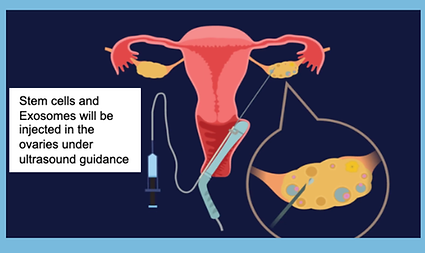
Mesenchymal stem cells (MSCs) are purchased from a USA-based company then shipped to the Bahamas. They are then carefully introduced into the ovaries using ultrasound-guided injection. Once in the ovarian tissue, these cells act as biological support cells, releasing growth factors and signaling molecules that may:
-
Reduce inflammation
-
Improve blood flow to the ovary
-
Support tissue repair
-
Improve the ovarian microenvironment
These effects may help support follicle health and overall ovarian function.
Exosome Therapy
Exosomes are tiny signaling particles naturally released by stem cells. They contain proteins that help cells communicate and repair tissue. One advantage of exosomes is that they do NOT contain nuclear DNA.
When delivered to the ovary, stem cell–derived exosomes may help:
-
Reduce inflammation and oxidative stress
-
Decrease tissue scarring (fibrosis)
-
Support cell survival and ovarian health
Because exosomes are cell-free, they provide regenerative signaling without introducing living cells.
Potential Outcomes
By improving the ovarian environment, these therapies may support:
-
Healthier follicle development
-
Hormonal balance
-
Improved ovarian function
-
Potential improved response to IVF when used as part of a comprehensive fertility plan
What You Should Know About Stem Cells & Exosomes for Fertility
🔹 Experimental but promising
Stem cell ovarian rejuvenation is considered an innovative therapy. While studies and early clinical data show encouraging results — including increased follicle activity and occasional pregnancies — larger, long-term trials are ongoing to establish consistent outcomes and safety profiles.
🔹 Not a guaranteed pregnancy
Results vary widely, and success depends on individual reproductive health and factors such as age and ovarian reserve.
🔹 Specialist evaluation required
A comprehensive fertility assessment — including hormone testing (e.g., AMH, FSH), ultrasound, and medical history review — is crucial before proceeding.
Who it may benefit?
-
Women over 40 years old
-
Menopause
-
Premature Ovarian Insufficiency (POI)
-
Low/Diminished Ovarian Reserve (low AMH, high FSH)
-
Poor egg/embryo quality
-
Recurrent miscarriage related to lining issues
-
Thin or poor-quality endometrium
-
Failed implantation / chemical pregnancy
-
Asherman’s syndrome
-
Vaginal dryness or discomfort with intercourse
-
Low libido
-
Excessive vaginal laxity
Potential Benefits
Benefits
-
Powerful cell-signaling support (exosomes contain high growth-factor content—often reported ~3× vs. adult stem cells)
-
Anti-inflammatory & anti-fibrotic actions
-
Flexible targeting (ovary, uterus, vagina)
-
Not all patients are candidates; a medical review is required

Why Choose Stem Cell Therapy at RFC Bahamas
At RFC Bahamas, we combine advanced regenerative science with personalized fertility care. Our protocols are designed to integrate the latest insights in stem cell and reproductive medicine to help you maximize your chances of achieving pregnancy and improved ovarian function at any age.

Frequently asked questions
Is stem cell therapy painful?
Most procedures are minimally invasive with little downtime. Anesthesia and careful monitoring help ensure comfort.
How long until results?
Improvement in ovarian function may take few weeks to several months as new tissue healing and follicle stimulation occur.
Can this replace IVF?
Stem cell therapy may improve ovarian conditions but may still be combined with IVF or other assisted reproductive technologies depending on your goals.
Fill out the form below to learn more about your eligibility
Scientific References
1. Exosome-focused ovarian rejuvenation
Cui, X., Li, H., Huang, X., Xue, T., Wang, S., Zhu, X., & Jing, X. (2025). Exosomes derived from mesenchymal stem cells repair ovarian function by suppressing NLRP3-mediated pyroptosis in cyclophosphamide-induced premature ovarian failure. Journal of ovarian research, 18(1), 216. https://doi.org/10.1186/s13048-025-01785-1
Tang, Y., He, Y., Huo, X., Chen, J., Qian, M., Huang, H., Meng, Y., Zhang, L., Xu, F., Zhang, Y., Bao, H., & Xiong, Y. (2025). hUMSC-derived exosomes alleviate follicular interstitial cell autophagy by let-7a-5p/AMPK/mTOR axis in POI rats. Stem cell research & therapy, 16(1), 291. https://doi.org/10.1186/s13287-025-04396-1
Chen, W., Feng, Q., Zhang, C., Yang, L., & Qi, J. (2025). Exosomes From Human Umbilical Cord Mesenchymal Stem Cells Alleviate Oxidative Stress-Induced POI by Regulating Autophagic Homeostasis Through the AMPK Pathway. Reproductive medicine and biology, 24(1), e12658. https://doi.org/10.1002/rmb2.12658
Ji, G., Wang, P., Kong, Z., Cao, X., Sun, Z., Yang, J., Zhao, X., Feng, H., & Hu, H. (2025). Human umbilical cord mesenchymal stem cells recover chemotherapy-induced premature ovarian failure. Frontiers in medicine, 12, 1681233. https://doi.org/10.3389/fmed.2025.1681233
Huang, C., Kong, N., Xue, P., Zhang, H., Ding, L., Wang, L., Zhou, J., Xing, J., Mei, J., & Sun, H. (2025). Transplantation of UC-MSCs in ovary improves ovarian function and intermediate outcomes in IVF/ICSI cycles of POI patients: a clinical cohort study. Stem cell research & therapy, 16(1), 552. https://doi.org/10.1186/s13287-025-04680-0