
IVF Success Rate: What Affects Your Outcome

Trying to make sense of IVF success rates can feel like decoding a secret language, especially for women navigating diminished ovarian reserve in their late thirties or early forties. Misconceptions about guaranteed results often add unnecessary stress to an already emotional journey. By understanding the real factors behind IVF outcomes and how innovative treatments like MRT are changing options worldwide, you can advocate for the right personalized solutions at leading clinics in places like the Bahamas. IVF Success Misconceptions can cloud judgment, but clear information and international expertise open new doors.
Table of Contents
Key Takeaways
Point | Details |
IVF Success is Not Guaranteed | IVF success rates vary significantly due to factors like age, underlying health, and clinic technology; patients should have realistic expectations. |
Understand Success Metrics | Familiarize yourself with different success metrics (e.g., clinical pregnancy rate vs. live birth rate) to make informed decisions about treatment options. |
Advancing Technologies Matter | New reproductive technologies enhance IVF outcomes; always consult your specialist about the latest options suitable for your profile. |
Consult for Personalization | Request personalized assessments and treatment strategies from your fertility specialist based on individual medical history and challenges. |
Defining IVF Success Rate and Common Myths
IVF success rates represent the probability of achieving a successful pregnancy through in vitro fertilization treatments. Contrary to popular belief, IVF is not a guaranteed solution but a complex medical procedure with varying outcomes. Modern fertility research reveals that most patients significantly overestimate their chances of success.
Understanding IVF success requires recognizing multiple influencing factors:
Patient’s age at treatment
Underlying fertility conditions
Quality of eggs and sperm
Reproductive medical history
Specific fertility clinic’s technological capabilities
Individual genetic factors
Common myths surrounding IVF often create unrealistic expectations. IVF Success Misconceptions include:
Believing IVF guarantees pregnancy
Assuming one treatment cycle will result in conception
Thinking younger patients always have higher success rates
Expecting identical outcomes for all patients
Statistically, global IVF research demonstrates that IVF accounts for approximately 2-5% of worldwide births, highlighting the procedure’s complexity and variability.
Pro Tip: Always request a personalized success rate assessment from your fertility specialist, which considers your unique medical profile and specific fertility challenges.
Different Measures of IVF Success Explained
IVF Success Metrics provide crucial insights into fertility treatment outcomes, revealing the complex landscape of reproductive medicine. Scientific research highlights that pregnancy success rates involve multiple nuanced definitions and measurement approaches.
Key measures of IVF success include:
Clinical Pregnancy Rate: Pregnancies confirmed by ultrasound
Live Birth Rate: Actual births resulting from treatment
Per Cycle Success Rate: Pregnancy outcomes per individual treatment cycle
Per Embryo Transfer Rate: Success measured by each embryo transfer attempt
Understanding these metrics is critical because fertility clinics utilize different reporting methods that can significantly impact perceived success rates. Some clinics strategically report rates that may appear more favorable by selecting specific measurement techniques.
Patients should pay close attention to these distinctions:
Clinical pregnancy does not guarantee live birth
Success rates vary dramatically by patient age
Multiple treatment cycles might be necessary
Individual medical history profoundly influences outcomes
Pro Tip: Request a comprehensive breakdown of success metrics from your fertility specialist, including live birth rates specific to your age group and medical condition.
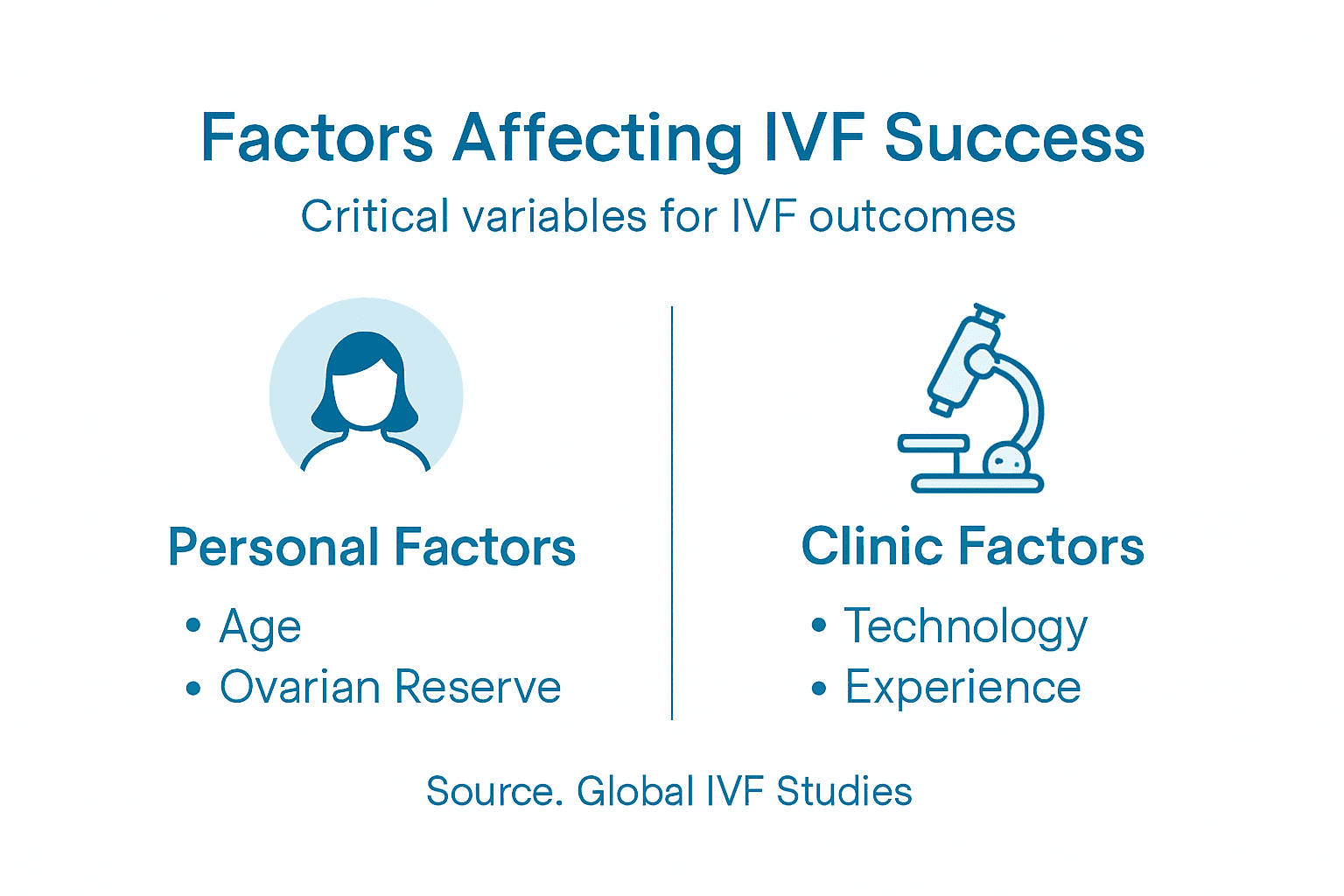
Major Factors Influencing IVF Success Rates
Reproductive Success depends on a complex interplay of biological and environmental factors that significantly impact IVF outcomes. Comprehensive fertility research reveals multiple critical elements influencing treatment effectiveness.
Key factors affecting IVF success include:
Female Age: Directly correlates with egg quality and quantity
Ovarian Reserve: Indicates remaining egg supply and reproductive potential
Sperm Quality: Critical for successful fertilization
Embryo Genetic Health: Determines implantation and pregnancy potential
Underlying Medical Conditions: Can impact fertility treatment outcomes
Lifestyle and external factors play a significant role in IVF success. Medical experts highlight that patient behaviors dramatically influence treatment results:
Smoking reduces fertility potential
Obesity negatively impacts reproductive outcomes
Chronic stress can interfere with hormonal balance
Nutrition plays a crucial role in reproductive health
Patients should understand that no single factor determines IVF success. Each individual’s journey is unique, requiring personalized medical approaches and realistic expectations.
Pro Tip: Consult a reproductive specialist to develop a comprehensive assessment of your personal fertility factors and potential treatment strategies.
Age and Ovarian Reserve: Key Impacts
Fertility Potential dramatically transforms with age, creating complex challenges for women seeking reproductive success. Research demonstrates that biological aging profoundly impacts reproductive capabilities, making early understanding crucial.
Key age-related fertility considerations include:
Egg Quantity Decline: Dramatic reduction in egg supply after age 35
Egg Quality Deterioration: Increased genetic abnormalities in older eggs
Chromosomal Risks: Higher probability of chromosomal disorders
Implantation Challenges: Reduced uterine receptivity with advancing age
IVF success rates reveal stark demographic differences, showing significant variations across age groups:
Ages 25-34: Highest reproductive potential
Ages 35-39: Noticeable fertility decline begins
Ages 40-44: Substantial reduction in natural conception rates
Ages 45+: Minimal spontaneous fertility potential
Ovarian reserve testing becomes increasingly critical as women age, providing essential insights into remaining reproductive potential and guiding personalized treatment strategies.

This quick reference table summarizes how age affects IVF outcomes:
Age Group | Average Egg Quality | Live Birth Rate (per cycle) | Recommended Action |
25-34 | High | 40-50% | Early assessment |
35-39 | Moderately reduced | 25-30% | Consider preservation |
40-44 | Low | 5-15% | Advanced intervention |
45+ | Very low | <5% | Explore alternatives |
Pro Tip: Consult a reproductive specialist before age 35 to develop a comprehensive fertility preservation strategy and understand your unique reproductive timeline.
Advanced Technologies and Success Improvement
Reproductive Technology continues to revolutionize fertility treatments, offering unprecedented opportunities for individuals struggling to conceive. Emerging scientific innovations are dramatically transforming IVF success rates and patient experiences.
Cutting-edge technologies enhancing IVF outcomes include:
Preimplantation Genetic Testing (PGT): Screening embryos for genetic abnormalities
Time-Lapse Embryo Imaging: Continuous monitoring of embryo development
Advanced Cryopreservation: Improved egg and embryo freezing techniques
Artificial Intelligence: Embryo selection and predictive modeling
Mitochondrial Replacement Therapy: Addressing genetic inheritance challenges
Innovative laboratory techniques have significantly transformed IVF practice, emphasizing:
Precision embryo assessment methods
Enhanced culture conditions
Single embryo transfer protocols
Personalized treatment strategies
These technological advances not only improve pregnancy rates but also reduce potential risks associated with multiple pregnancies, making fertility treatments safer and more effective.
Pro Tip: Request a comprehensive consultation discussing the latest technological interventions specific to your individual fertility profile and potential treatment options.
Comparing IVF Alternatives and Treatment Options
Fertility Treatment landscapes offer multiple pathways for individuals struggling with conception. Comparative reproductive research reveals several assisted reproductive technologies with unique characteristics and success potential.
Primary fertility treatment alternatives include:
Intrauterine Insemination (IUI): Less invasive, lower cost
In Vitro Fertilization (IVF): Higher success rates, more complex procedure
Gamete Intrafallopian Transfer (GIFT): Surgical intervention with specific applications
Intracytoplasmic Sperm Injection (ICSI): Specialized fertilization technique
Medical Management: Hormone therapies and pharmaceutical interventions
Specific fertility diagnosis
Patient’s age and reproductive history
Financial considerations
Personal medical complexity
Previous treatment outcomes
Each approach carries distinct advantages and limitations, necessitating comprehensive medical consultation to determine the most appropriate strategy for individual reproductive challenges.
To better understand IVF compared to other reproductive options, see this concise comparison:
Treatment Type | Invasiveness | Approximate Success Rate | Typical Cost |
IUI | Minimally invasive | Lower than IVF | Lower ($500-$1,000 per cycle) |
IVF | Moderately invasive | Higher, age-dependent | Higher ($10,000-$15,000 per cycle) |
GIFT | Surgical procedure | Variable, rarely used | Comparable to IVF |
ICSI | Used with IVF for male infertility | Similar to IVF | Slightly higher than IVF |
Medical Management | Medication-based | Depends on diagnosis | Lowest ($50-$500) |
Pro Tip: Request a comprehensive fertility assessment that evaluates your unique medical profile and explores multiple treatment pathways before committing to a specific intervention.
Unlock Your IVF Success with Advanced Fertility Solutions
Understanding what affects your IVF success rate is the first critical step toward achieving your dream of parenthood. Factors like age, ovarian reserve, and embryo quality can feel overwhelming. If you are facing challenges such as poor ovarian reserve, genetic concerns, or multiple previous IVF attempts without success, specialized treatments might be your key to improved outcomes. At the Rejuvenating Fertility Center in the Bahamas, we combine cutting-edge technologies like Mitochondrial Replacement Therapy and Stem Cell Therapy with personalized care to address these specific obstacles.
Don’t let uncertainty hold you back. Discover how innovative approaches to fertility can enhance your chances with proven scientific methods led by Dr. Zaher Merhi. Visit Rejuvenating Fertility Center to explore advanced IVF options, egg freezing, and rejuvenation therapies tailored just for you. Take action today because timing matters when it comes to fertility success. Schedule your consultation now and start turning hope into reality.
Frequently Asked Questions
What factors influence the success rates of IVF?
The success rates of IVF are influenced by several factors, including the patient’s age, underlying fertility conditions, quality of eggs and sperm, reproductive medical history, the technological capabilities of the fertility clinic, and individual genetic factors.
How can I improve my chances of a successful IVF outcome?
Improving your chances of a successful IVF outcome may involve lifestyle changes such as quitting smoking, maintaining a healthy weight, managing stress, and following a nutritious diet. Consulting with a reproductive specialist can also provide personalized recommendations based on your unique medical profile.
What are the different measures of IVF success rates?
IVF success rates can be measured in several ways, including clinical pregnancy rates (pregnancies confirmed by ultrasound), live birth rates (actual births resulting from treatment), per cycle success rates (outcomes per treatment cycle), and per embryo transfer rates (success per embryo transfer attempt).
Does age impact IVF success rates significantly?
Yes, age significantly impacts IVF success rates. Younger women typically experience higher success rates due to better egg quality and quantity, while older women may face lower success potential due to factors like decreased ovarian reserve and increased chromosomal abnormalities.
Recommended
I visited an ICSI fertility clinic in London after discussing my fertility concerns with a specialist. I was happy with how carefully my situation was reviewed and how the treatment process was explained to me. The clear communication and supportive approach made the experience much easier to understand.
Great article with valuable insights into fertility treatment. It clearly explains how factors like age, lifestyle, and overall health can influence IVF outcomes, making it easy for readers to understand. This is a helpful resource not only for anyone wondering Can Obesity Affect IVF Success Rates, but also for couples searching for a trusted IVF Centre in Punjab for expert fertility care. Keep sharing such informative and patient-focused content!