
What Is Elective Egg Freezing and Who Benefits?

For women facing diminished ovarian reserve or fertility worries, modern egg freezing offers hope and control. More than 30 percent of American women who delay motherhood cite concerns about losing their fertility window. That reality has driven a surge in innovative techniques from global clinics empowered to preserve eggs at peak quality. Discover how advanced reproductive options can support your family plans while keeping your choices open for the future.
Table of Contents
Key Takeaways
Point | Details |
Elective Egg Freezing Provides Control | Women can preserve their fertility by freezing eggs, allowing them to delay childbearing based on personal or professional reasons. |
Success Rates Depend on Age | The likelihood of successful thawing and pregnancy is significantly higher for women under 35 years old. |
Comprehensive Assessment Is Vital | Before pursuing egg freezing, individuals should seek a thorough fertility assessment to optimize their chances for success. |
Advanced Technologies Enhance Preservation | Modern methods like vitrification minimize damage to eggs, improving the potential for future pregnancies. |
Defining Elective Egg Freezing and Core Concepts
Elective egg freezing is an advanced reproductive technology that empowers women to preserve their fertility potential by strategically storing healthy eggs for future use. The process involves carefully extracting and cryopreserving high-quality eggs during a woman’s most fertile years, creating a biological insurance policy against age-related fertility decline.
At its core, egg freezing represents a scientifically sophisticated method of oocyte cryopreservation, which allows women to pause their biological clock. The procedure typically involves several critical steps: hormonal stimulation to encourage multiple egg maturation, transvaginal egg retrieval, and immediate freezing through advanced vitrification techniques. Unlike traditional fertility preservation methods, elective egg freezing gives women unprecedented control over their reproductive timeline.
The primary motivation for elective egg freezing often stems from personal, professional, or medical considerations. Women might choose this option when they want to delay childbearing due to career goals, haven’t found the right partner, or wish to protect their fertility before medical treatments that could potentially compromise reproductive health. Success rates vary significantly, with younger women (typically under 35) experiencing higher preservation and future fertilization potential.
Pro Tip: Schedule a comprehensive fertility assessment before beginning the egg freezing process to understand your unique reproductive health profile and optimize your chances of successful egg preservation.
Who Chooses Egg Freezing and Why It Matters
Women across diverse backgrounds are increasingly choosing elective egg freezing as a strategic approach to reproductive autonomy. Individuals facing various life circumstances recognize this technology as a powerful method to protect their future fertility options. The motivations range from professional ambitions to personal health considerations, reflecting a nuanced understanding of reproductive planning in the modern world.

Typical candidates for egg freezing include professionals navigating complex career trajectories, women who haven’t yet found their ideal partner, and individuals confronting medical challenges that could compromise reproductive potential. Medical scenarios such as upcoming cancer treatments, genetic predispositions to early menopause, or autoimmune conditions make egg freezing particularly compelling. Women experiencing fertility challenges find this technology offers a scientifically advanced pathway to preserve biological potential.
Beyond individual circumstances, egg freezing represents a profound statement of reproductive choice. Transgender and non-binary individuals may pursue this option before gender-affirming treatments, while others use it as a form of biological insurance against future uncertainty. The procedure empowers individuals to make proactive decisions about their reproductive health, decoupling fertility from immediate reproductive timelines and providing unprecedented flexibility.
Here’s a summary of major candidate groups and their reasons for elective egg freezing:
Candidate Group | Primary Reason | Key Considerations |
Young professionals | Career planning | Desire for timing control |
Patients with medical risk | Cancer or menopause risk | Protection before medical treatments |
People without partners | Relationship timing | Flexibility for future choices |
Trans/non-binary individuals | Gender-affirming treatments | Preserve fertility pre-transition |
Pro Tip: Consult a reproductive endocrinologist for a comprehensive fertility assessment to determine the optimal timing and approach for your personal egg freezing journey.
The Egg Freezing Process Step by Step
The egg freezing process is a carefully orchestrated medical procedure designed to preserve a woman’s reproductive potential. Women considering this option will typically undergo a comprehensive fertility treatment approach that involves multiple precise stages, each meticulously planned to maximize egg quality and preservation potential.
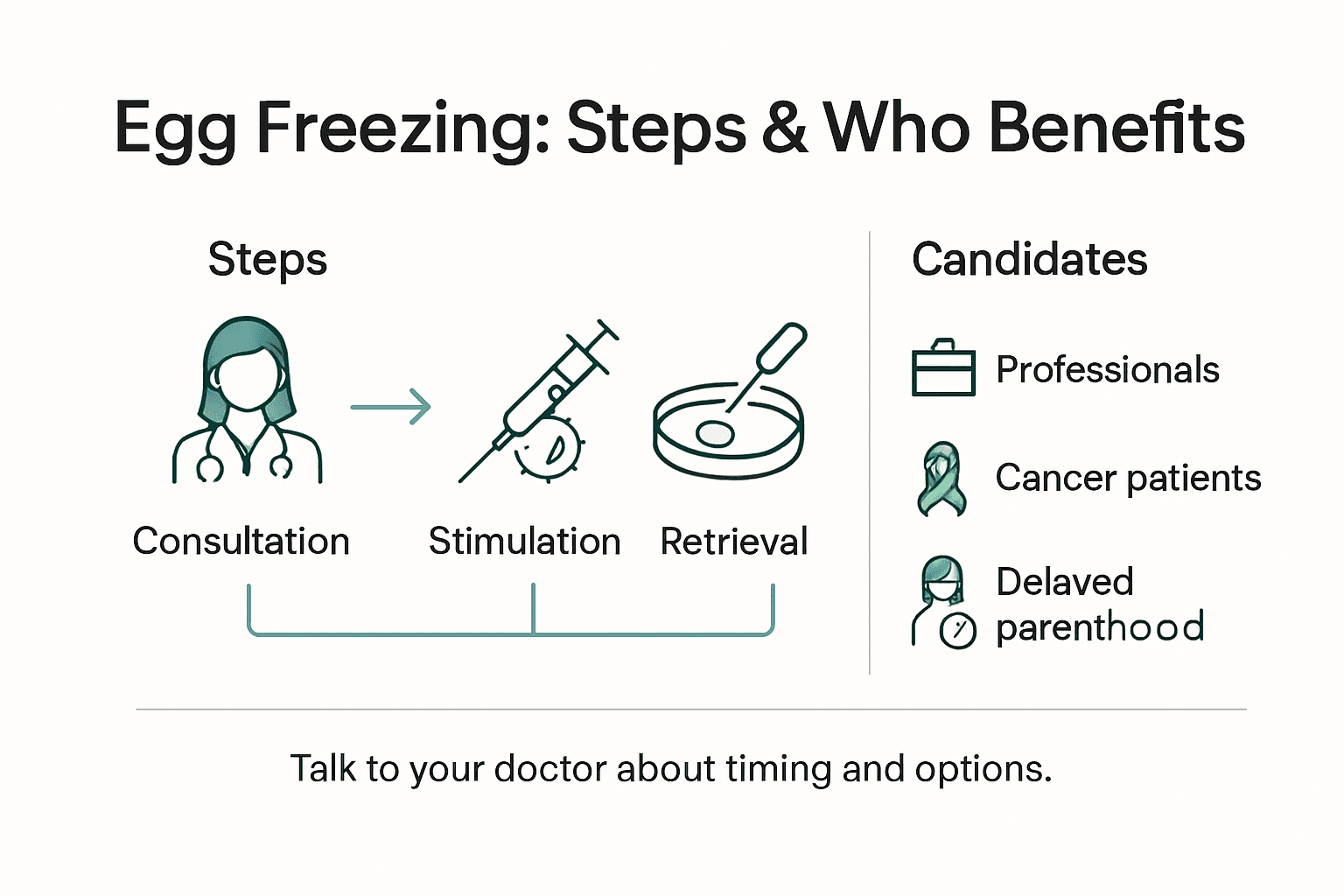
The procedure begins with an initial consultation and fertility assessment, where medical professionals conduct comprehensive hormonal and reproductive health screenings. During the next phase, patients undergo ovarian stimulation through carefully calibrated hormone injections, which encourage the ovaries to produce multiple mature eggs. This stimulation typically spans 10-14 days, during which patients are closely monitored through ultrasound and blood tests to track egg development and hormonal responses.
The egg retrieval process is a minimally invasive surgical procedure performed under sedation. Using transvaginal ultrasound guidance, physicians carefully extract mature eggs from the ovaries. Immediately following retrieval, embryologists employ advanced vitrification techniques to rapidly freeze the eggs, preserving their cellular integrity and potential for future fertilization. These frozen eggs are then carefully stored in specialized cryogenic facilities, maintaining their biological potential until the patient decides to pursue pregnancy.
Pro Tip: Maintain open communication with your reproductive endocrinologist and undergo comprehensive genetic screening to optimize your egg freezing strategy and potential future success.
Success Rates, Safety Risks, and Misconceptions
Egg freezing presents a nuanced landscape of potential success and complex medical considerations. Pregnancy success rates vary significantly based on age and individual factors, with women who freeze eggs before age 38 experiencing approximately 70% chances of eventually having a baby when thawing at least 20 eggs.
Critical medical risks accompany the procedure, including potential hormonal side effects and rare but serious complications. Ovarian hyperstimulation syndrome represents a significant concern, ranging from mild to severe manifestations. Retrieval procedures carry inherent risks such as bleeding and infection, requiring patients to carefully weigh potential medical challenges against reproductive opportunities. Comprehensive medical counseling helps patients understand realistic expectations, dispelling common myths about guaranteed pregnancy outcomes.
The most pervasive misconceptions surrounding egg freezing often stem from unrealistic expectations about fertility preservation. Many individuals mistakenly believe that freezing eggs guarantees future pregnancy, when in reality, success depends on numerous complex factors including egg quality, age at freezing, and individual reproductive health. Live birth rates demonstrate a steep decline after age 35, highlighting the importance of strategic timing and informed decision making throughout the fertility preservation process.
Pro Tip: Consult multiple reproductive specialists and undergo comprehensive genetic screening to develop the most accurate understanding of your personal fertility potential.
Costs, Clinic Selection, and Legal Concerns
Elective egg freezing represents a significant financial and legal investment that requires careful strategic planning. The total cost typically ranges from $10,000 to $20,000, encompassing initial consultations, hormone treatments, egg retrieval procedures, and long-term storage fees. Women must consider not just upfront expenses, but ongoing maintenance costs that can accumulate over multiple years of preservation.
Employer-funded egg freezing programs introduce complex workplace dynamics that extend beyond simple financial coverage. While these initiatives can improve reproductive autonomy, they simultaneously raise critical questions about workplace equity, potential subtle discrimination, and the broader implications of corporate involvement in personal reproductive decisions. Legal considerations become paramount, with potential risks surrounding privacy, future employment opportunities, and the nuanced interpretation of such benefits.
Selecting the right fertility clinic demands comprehensive research and careful evaluation. Prospective patients should assess clinical success rates, physician expertise, technological capabilities, and comprehensive support services. Critical factors include the clinic’s experience with egg freezing, their vitrification techniques, storage protocols, and transparent communication about potential outcomes. Patients must also investigate the legal framework surrounding egg storage, potential use scenarios, and consent protocols that govern future reproductive choices.
Pro Tip: Request detailed written documentation about storage protocols, future usage rights, and comprehensive cost breakdowns before committing to any egg freezing program.
Advanced Innovations in Egg Freezing Technology
Reproductive technology has undergone a remarkable transformation, with egg freezing standing at the forefront of scientific innovation. Modern fertility preservation techniques now employ cutting-edge flash-freezing methods like vitrification, which dramatically reduce cellular damage by preventing ice crystal formation during the preservation process.
Advanced embryo culture systems have revolutionized the field, enabling more precise and successful egg preservation. Specialized laboratories now maintain stringent temperature-controlled environments with sophisticated monitoring technologies that ensure optimal specimen handling. These technological breakthroughs include precision genetic screening, advanced cryogenic storage protocols, and innovative techniques that can assess and potentially improve egg quality before freezing.
The following table compares traditional egg freezing and modern vitrification technologies:
Preservation Method | Freezing Speed | Egg Quality Outcome | Typical Usage Scenario |
Slow freezing | Several hours | Higher risk of ice damage | Early egg freezing methods |
Vitrification | Seconds to minutes | Minimized cellular damage | Current fertility clinics |
Beyond traditional freezing methods, emerging technologies are exploring groundbreaking approaches to fertility preservation. Researchers are developing techniques like mitochondrial replacement therapy and stem cell interventions that could potentially enhance egg quality and reproductive potential. These innovations represent a paradigm shift, moving from simple preservation to active reproductive optimization, offering women unprecedented control over their biological timelines and reproductive choices.
Pro Tip: Research fertility clinics that utilize the most advanced vitrification technologies and offer comprehensive genetic screening to maximize your egg preservation potential.
Take Control of Your Fertility Journey with Advanced Egg Freezing Solutions
Elective egg freezing offers a pathway to preserve your fertility on your own terms but navigating this complex process requires expert guidance and cutting-edge technology. At Rejuvenating Fertility Center, we understand the challenges of hormonal stimulation, egg retrieval, and maximizing egg quality with advanced vitrification. Our personalized approach addresses concerns like diminished ovarian reserve and genetic risks through innovative options such as Mitochondrial Replacement Therapy and Stem Cell Therapy, helping boost your future pregnancy success.
Empower your reproductive future today by choosing a leader in fertility science trusted by international patients. Schedule your comprehensive fertility assessment with Dr. Zaher Merhi and explore how tailored egg freezing combined with ovarian rejuvenation treatments can give you unmatched reproductive flexibility. Visit Rejuvenating Fertility Center now to start your consultation and learn about our proven egg freezing programs designed just for you.
Frequently Asked Questions
What is elective egg freezing?
Elective egg freezing is a reproductive technology that allows women to preserve their fertility by storing healthy eggs for future use. It involves a process of ovarian stimulation, egg retrieval, and cryopreservation.
Who should consider elective egg freezing?
Women may consider elective egg freezing for various reasons, including career aspirations, relationship timing, or medical conditions such as cancer treatments that could impact fertility. It offers reproductive autonomy and flexibility for future family planning.
How does the egg freezing process work?
The egg freezing process typically includes an initial fertility assessment, hormonal stimulation to encourage egg maturation, a minimally invasive retrieval procedure, and immediate freezing of the eggs using advanced vitrification techniques.
What are the success rates of egg freezing?
Success rates for egg freezing vary based on age and individual factors. Women who freeze their eggs before age 38 have approximately a 70% chance of having a baby when thawing at least 20 eggs, highlighting the importance of age during the freezing process.
Recommended
Comments