
Why Pursue IVF Abroad: Expanded Options for 2026

Finding reliable answers about advanced IVF options abroad can feel complicated, especially when your hopes rest on treatments like mitochondrial replacement or stem cell therapy. For many couples over 40 with diminished ovarian reserve, local clinics may not offer the latest therapies or flexible eligibility rules. This guide brings clarity to common misconceptions about IVF abroad, with a special focus on innovative reproductive treatments available in the Bahamas so you can make informed decisions for your parenthood journey.
Table of Contents
Key Takeaways
Point | Details |
IVF Abroad Can Offer Advanced Options | Traveling for fertility treatment often provides access to innovative therapies that are not available or are severely restricted at home. |
Misconceptions Can Hinder Decisions | Common myths about international IVF services often prevent qualified candidates from exploring beneficial options. |
Cost and Accessibility Are Significant Factors | Couples pursuing IVF abroad can typically save 40-60% on treatment costs, making advanced therapies more financially accessible. |
Care Coordination Is Key | Effective follow-up care can be maintained through coordinated communication between international clinics and local healthcare providers. |
IVF Abroad Defined and Common Misconceptions
When you hear “IVF abroad,” you’re looking at traveling to another country specifically for in vitro fertilization and related fertility treatments. It’s not a vacation that happens to include a medical procedure—it’s a deliberate choice to access reproductive medicine unavailable or prohibitively expensive at home.
For couples over 40 with diminished ovarian reserve, this typically means seeking advanced options like mitochondrial replacement therapy or stem cell therapies for ovarian rejuvenation. These treatments remain experimental or restricted in most countries, making medical travel not just appealing but often necessary.

What IVF Abroad Actually Means
IVF abroad encompasses several distinct scenarios:
Traveling for standard IVF when your home country has long wait times or limited access
Seeking specialized therapies like platelet-rich plasma (PRP) or autologous stem cell therapy unavailable locally
Accessing advanced genetic testing and embryo selection protocols
Combining fertility treatment with egg freezing or embryo preservation
Pursuing innovative mitochondrial optimization strategies
Advanced fertility treatments abroad often represent medical solutions tailored to your specific diagnosis rather than one-size-fits-all protocols.
The Myths Holding People Back
Misconceptions about international fertility treatment stop many qualified candidates from exploring options that could work. Let’s address the most common ones.
Myth 1: It’s only for those who can’t conceive naturally anywhere. False. Many patients pursue treatment abroad because they want advanced ovarian rejuvenation approaches proven more effective for their age and reserve profile than traditional IVF alone.
Myth 2: Clinics abroad have lower standards than home. The reality is more nuanced. Leading fertility centers abroad maintain or exceed accreditation standards from your home country. What differs is innovation—not safety.
Myth 3: You’ll compromise on follow-up care. Modern practice allows seamless coordination with your home fertility specialist. Initial monitoring happens abroad, then your local doctor manages subsequent pregnancy care.
Myth 4: The cost savings aren’t real. Treatment abroad typically costs 40–60% less than North American equivalents, even accounting for travel and accommodation. For couples seeking cutting-edge therapies like mitochondrial replacement, the difference becomes even more significant.
Advanced treatments abroad aren’t a backup plan—they’re a strategic option for patients whose biological profile demands innovation over convention.
Myth 5: Travel will compromise treatment success. Medical outcomes depend on protocol, egg quality, and embryo viability—not geographical location. Coordinated care across borders works effectively when clinics have structured communication.
Pro tip: During your initial consultation, ask potential clinics specifically about their coordination protocols with North American fertility specialists and request written procedures for medical record sharing.
Key Motivations for Seeking Treatment Internationally
Your decision to pursue IVF abroad rarely comes from a single factor. It’s typically a combination of medical necessity, practical constraints, and the pursuit of better outcomes. Understanding what drives couples over 40 to cross borders for fertility treatment helps clarify whether international care aligns with your goals.
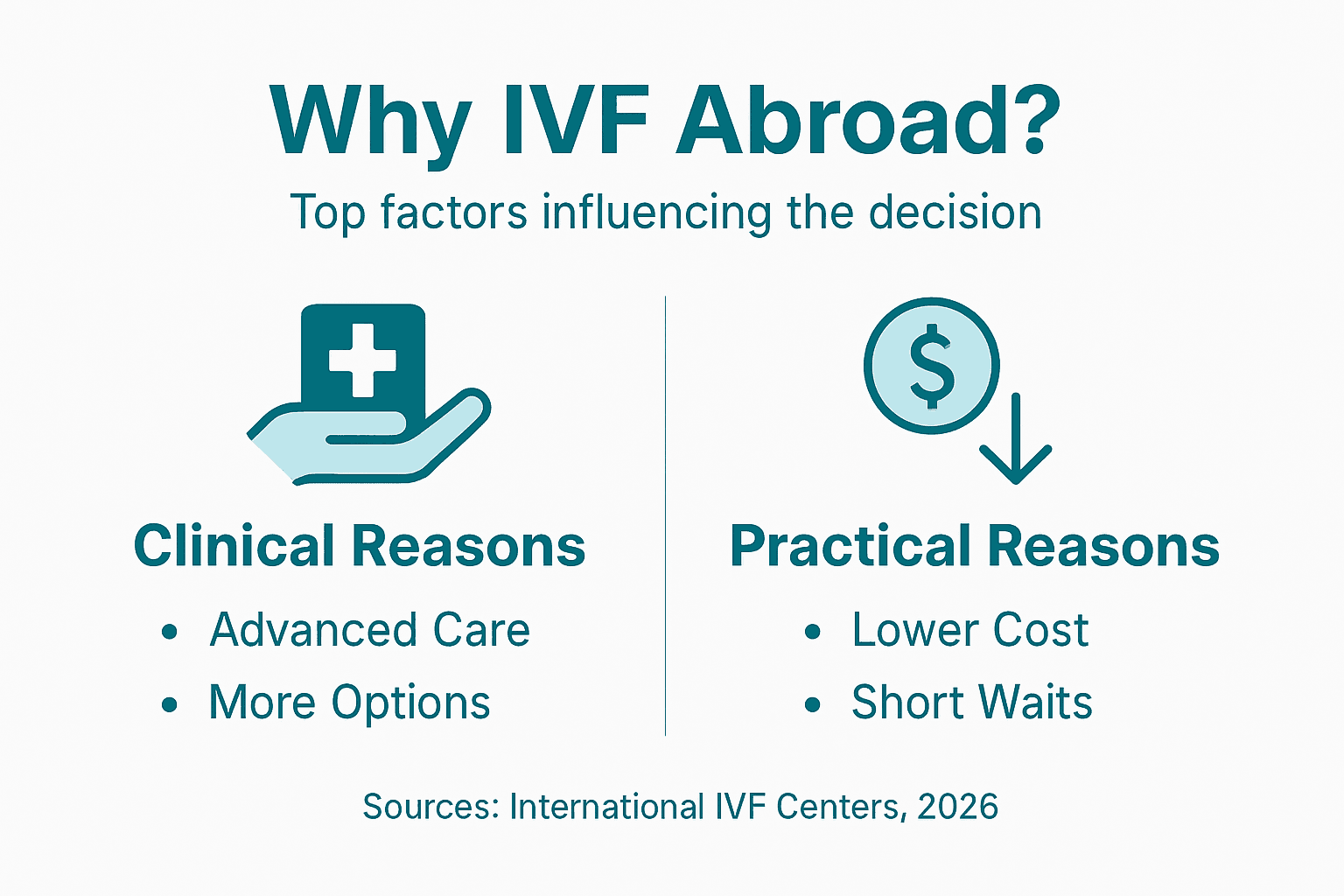
The motivations fall into several overlapping categories. Some are clinical—your age and ovarian reserve profile demand advanced therapies. Others are logistical—wait times, cost, or lack of available expertise at home. Still others are psychological—the desire to pursue treatment without the emotional weight of repeated failures in your home healthcare system.
Medical Necessity
For women over 40 with diminished ovarian reserve, clinical factors often become the primary driver. Standard IVF protocols simply don’t address the core problem: mitochondrial dysfunction and cellular aging that compromise egg quality.
Advanced options available internationally include:
Mitochondrial replacement therapy (MRT) to address age-related energy deficits in eggs
Stem cell therapies for ovarian rejuvenation designed to improve follicle quality and reserve
Platelet-rich plasma (PRP) protocols that stimulate ovarian tissue regeneration
Comprehensive genetic testing with advanced embryo selection protocols
Customized stimulation protocols tailored to your specific reserve profile
Your local clinic may offer standard IVF. They rarely offer the specialized interventions that address why standard IVF has failed repeatedly.
Psychological and Environmental Factors
Research on psychosocial factors influencing fertility treatment reveals that emotional and environmental context shapes treatment decisions significantly. The stress of repeated cycles in your home country—where you see the same clinic staff after each failure—creates psychological burden that international treatment can relieve.
Traveling for treatment offers psychological benefits beyond medical ones:
Fresh start with providers unfamiliar with your previous failures
Reduced anxiety from changing physical environment
Time to focus on treatment without work-related stress
Opportunity to view fertility care as a deliberate investment rather than repeated attempts
The decision to pursue treatment internationally often reflects both clinical reasoning and the emotional need for a reset.
Practical and Economic Drivers
Cost differences are substantial. Standard IVF cycles in North America range from $12,000 to $15,000. Advanced treatments like mitochondrial replacement or stem cell therapies cost $25,000 to $40,000 domestically.
International treatment typically costs 40–60% less while incorporating these advanced protocols. For couples pursuing multiple cycles or cutting-edge options, the financial difference becomes transformative.
Wait times also matter. Many public healthcare systems impose age-based restrictions or lengthy waits. International clinics accept patients immediately and accommodate schedules flexibly.
Pro tip: Before committing internationally, calculate your total out-of-pocket cost including all cycles, travel, and accommodation—not just the procedure cost—to accurately compare against domestic options.
Innovative Technologies and Therapies Offered Abroad
International fertility clinics don’t just offer IVF—they offer a fundamentally different technological landscape. The procedures available abroad represent the cutting edge of reproductive medicine, often years ahead of what your home country permits or funds.
For couples over 40 with diminished ovarian reserve, access to these technologies can mean the difference between another failed cycle and a viable pregnancy. Understanding what’s actually available helps you evaluate whether traveling makes clinical sense for your situation.
Advanced Embryo Assessment
One of the most significant advances reshaping fertility outcomes involves embryo evaluation. Preimplantation genetic testing (PGT) screens embryos for chromosomal abnormalities before transfer, dramatically improving success rates for women over 40 whose eggs carry higher rates of aneuploidy.
Beyond traditional PGT, international clinics increasingly employ artificial intelligence for embryo selection. Machine learning algorithms analyze thousands of embryo images, identifying morphological markers invisible to human assessment.
These AI-driven protocols work particularly well for women with diminished reserve because they maximize the potential of fewer, lower-quality eggs:
AI morphology analysis identifies the highest-viability embryos from limited cohorts
Comprehensive chromosomal screening reduces implantation failure from genetic abnormalities
Metabolic profiling assesses embryo potential based on cellular energy indicators
Time-lapse imaging monitors embryo development continuously without removal from incubators
Ovarian Rejuvenation and Regenerative Therapies
While your age is fixed, your egg quality isn’t. Advanced clinics offer therapies specifically designed to improve mitochondrial function and ovarian tissue response, directly addressing the root cause of poor outcomes in women over 40.
Mitochondrial replacement therapy (MRT) transfers healthy mitochondria into aging eggs, restoring cellular energy production. Stem cell therapies activate dormant follicles and improve blood flow to ovarian tissue. Platelet-rich plasma (PRP) stimulates regeneration at the cellular level.
These aren’t theoretical. They’re available now in established international fertility hubs, with documented success improving egg quality metrics in women previously labeled “poor responders.”
The following table summarizes how innovative IVF technologies abroad address common challenges for women over 40:
Challenge | Advanced Solution Abroad | How It Improves Outcomes |
Low egg quality | Mitochondrial replacement, PRP | Enhances cellular energy, regeneration |
High embryo aneuploidy | Comprehensive PGT, AI selection | Screens viable embryos more accurately |
Small egg/embryo numbers | AI morphology analysis, optimized stimulation | Maximizes success from limited eggs |
Past IVF failure | Stem cell therapy, tailored protocol | Directly targets ovarian reserve issues |
Emerging Precision Technologies
Research on micro and nanorobotics in reproductive medicine demonstrates that precision automation enhances egg retrieval, sperm selection, and embryo handling with unprecedented accuracy. These technologies reduce manual handling trauma while improving selection specificity.
Miniaturized robotics promise:
Reduced invasiveness during egg retrieval procedures
Enhanced sperm selection accuracy for male factor cases
Improved embryo manipulation without mechanical damage
Lower contamination risk during handling
The convergence of AI, genetic testing, and regenerative medicine creates treatment options specifically designed for the biological challenges of advancing age.
Freezing and Storage Innovation
Vitrification (ultra-rapid freezing) has transformed egg and embryo preservation. Survival rates now exceed 95%, making it viable to freeze eggs during better-responding cycles for use later.
This matters significantly for women over 40 pursuing multiple retrievals or considering mitochondrial optimization across multiple cycles.
Pro tip: Ask international clinics specifically which AI systems they use for embryo selection and request published validation data—not all AI programs have equivalent accuracy.
Legal, Eligibility, and Cost Considerations by Country
The rules governing who can access IVF, what procedures are permitted, and what you’ll pay shift dramatically depending on where you travel. A treatment perfectly legal and affordable in one country may be restricted or prohibitively expensive in another.
Understanding these differences before committing to travel saves time, money, and emotional energy. For couples over 40 with diminished ovarian reserve, eligibility criteria and available procedures become especially important since your options narrow with age.
Age Limits and Eligibility Variations
Legal frameworks for IVF vary significantly between countries, affecting who qualifies based on age, marital status, and sexual orientation. Some countries permit treatment up to age 50 or beyond under specific conditions. Others enforce strict age cutoffs at 45 or 46.
The Bahamas, as an international fertility destination, attracts patients specifically because it permits advanced therapies for women outside typical age restrictions, particularly those pursuing mitochondrial replacement or stem cell therapies.
Why age matters: Many women over 40 face rejection from their home healthcare systems based on age alone, regardless of their individual health status or treatment potential.
Procedure-Specific Restrictions
Not all countries permit the same procedures. Mitochondrial replacement therapy (MRT) remains illegal in most places. Stem cell therapies for ovarian rejuvenation operate in regulatory gray zones in many countries.
Procedure availability by category:
Standard IVF and egg freezing: Available in most countries
Donor egg IVF: Permitted almost everywhere but with varying legal restrictions on donor anonymity
Mitochondrial replacement: Severely restricted; available in very few locations
Stem cell therapies: Emerging availability in established fertility tourism hubs
PRP and platelet therapies: Increasingly available internationally
Understanding IVF eligibility abroad requires assessing both national laws and individual clinic policies around your specific procedure needs.
Cost Structure by Destination
Costs vary dramatically. Spain and Czech Republic offer strong regulatory environments with moderate pricing. Greece delivers affordable treatment with excellent outcomes. Each has different cost structures for advanced therapies.
Typical cost ranges for standard IVF abroad: $5,000–$9,000 per cycle.
Advanced therapies like mitochondrial optimization or stem cell treatment: $15,000–$25,000 depending on destination and protocol complexity.
Here’s a comparison of IVF eligibility, advanced treatment access, and typical costs in popular international destinations:
Country | Age Limit for Own-Egg IVF | Advanced Treatments Offered | Typical IVF Cost per Cycle |
Bahamas | Up to 50 (case by case) | Mitochondrial, Stem Cell, PRP, PGT, AI | $8,000–$15,000 |
Spain | Usually 50 | PGT, Donor IVF, Egg Freezing, AI | $6,000–$9,000 |
Czech Republic | Usually 49 | Donor IVF, PGT, Egg Freezing | $5,000–$8,000 |
Greece | Up to 54 (case by case) | PGT, Donor IVF, Egg Freezing | $5,000–$8,000 |
USA/Canada | Often <46 by clinic policy | Fewer advanced options, strict on MRT | $12,000–$15,000 (standard) |
Your total investment includes procedure cost, travel, accommodation, time off work, and potentially multiple cycles—not just the clinic fee.
Questions to Ask Specific Clinics
Before committing, verify these critical details:
What is your maximum age limit for own-egg IVF versus donor egg protocols?
Which advanced therapies do you offer, and are there legal restrictions in your country?
What communication protocols exist with my home fertility specialist for follow-up care?
If I require additional cycles, what’s the turnaround time?
Are medication costs included in your quoted fees?
Pro tip: Request written documentation of your country’s specific legal framework governing your proposed treatment, not just clinic assurances—regulatory status changes, and you need clarity on what applies when you travel.
Risks, Safety, and Choosing a Reputable Clinic
Traveling abroad for fertility treatment introduces real risks that don’t exist with local care. Language barriers, differing regulatory standards, and logistical gaps in follow-up create safety considerations you must understand before proceeding.
This doesn’t mean international treatment is unsafe. It means you need to choose carefully and understand what you’re accepting when you cross borders for care.
Understanding the Actual Risks
Fertility treatment abroad carries inherent risks due to differing regulations, potential communication challenges, and logistical complications in ongoing care. These aren’t theoretical—they’re documented concerns from regulatory bodies worldwide.
The specific risks include:
Regulatory gaps: Different countries have different accreditation requirements and oversight mechanisms
Language barriers: Miscommunication about protocols, side effects, or complications becomes possible
Follow-up complications: Medical records transfer slowly; your home doctor may lack context about your treatment
Multiple pregnancy risks: Some clinics transfer multiple embryos, increasing risks of multiples
Medication quality variation: Pharmaceutical standards differ between countries
None of these automatically disqualify international treatment. They simply require you to mitigate them actively.
Vetting Clinic Credentials and Experience
Reputable international clinics share specific markers. Start here before scheduling anything.
Non-negotiable clinic credentials:
Regulatory accreditation from their home country’s health authority
Published success rates specific to your age and diagnosis (not just overall statistics)
Transparent pricing with no hidden fees or pressure to purchase packages
Documented experience with advanced therapies like mitochondrial replacement or stem cell treatment
Established follow-up protocols with detailed written communication procedures
Board-certified embryologists and physicians with verifiable credentials
When evaluating a clinic, ask for references from North American patients who’ve completed treatment. Reputable clinics provide them readily.
Red Flags and What to Avoid
Certain warning signs indicate you should look elsewhere:
Clinics guaranteeing pregnancy or success rates
Pressure to commit immediately without time for research
Unavailability for consultation calls before booking
Refusal to communicate directly with your home fertility specialist
Lack of published accreditation or licensing information
Promises of unproven treatments with exaggerated claims
The cheapest clinic is rarely the best choice. Safety and experience command fair pricing.
Building Your Safety Protocol
Once you’ve selected a clinic, establish clear communication structures before treatment begins. A fertility consultation with your home specialist beforehand creates continuity.
Your pre-travel safety checklist:
Confirm your home fertility specialist will accept transfer of medical records from abroad
Obtain written protocols for emergency complications during treatment
Request detailed written information about all medications and protocols in English
Establish a point person at the international clinic for questions
Schedule a post-treatment consultation with your home doctor before any embryo transfer
Pro tip: Request a detailed written treatment plan in English before arriving, including medication protocols, monitoring schedules, and contingency plans for low response or complications—this prevents miscommunication later.
Discover Advanced IVF Options Tailored for Women Over 40
Facing diminished ovarian reserve and looking beyond standard IVF treatments can feel overwhelming. This article highlights the critical challenges such as mitochondrial dysfunction and limited egg quality that traditional fertility approaches often cannot solve. At Rejuvenating Fertility Center in the Bahamas, we focus on cutting-edge therapies like Mitochondrial Replacement Therapy and Stem Cell Therapy for ovarian rejuvenation designed specifically to improve egg quality and embryo viability for women over 40.
If you are seeking a fresh start with innovative protocols and personalized care led by Dr. Zaher Merhi, you can explore how our advanced reproductive medicine solutions at Rejuvenating Fertility Center can help you. Learn more about our unique approach to treatments like mitochondrial optimization and regenerative therapies and why international patients choose us as their trusted destination for fertility care. Take control of your fertility journey now by scheduling a consultation to discuss tailored options available only through specialized clinics abroad.
Frequently Asked Questions
What are the main reasons for pursuing IVF abroad?
Many couples consider IVF abroad due to a combination of medical necessity, logistical challenges like long wait times and high costs, and the opportunity to access advanced treatments that may not be available in their home country.
What advanced treatments can I access when pursuing IVF internationally?
International clinics often offer specialized therapies such as mitochondrial replacement therapy, stem cell therapies for ovarian rejuvenation, and advanced genetic testing that may not be readily available or permitted in your home country.
How do costs for IVF abroad compare to treatments in North America?
Treatment abroad typically costs 40–60% less than equivalent procedures in North America, even when factoring in travel and accommodation expenses. For couples seeking advanced therapies, the financial difference can be even more significant.
What should I consider when choosing an international fertility clinic?
When selecting an international clinic, ensure they have proper accreditation, transparent pricing, documented success rates, and a clear communication plan for follow-up care with your home fertility specialist.
Recommended
Comments