
Defining Alternative Fertility Options for Women Over 40

When facing the reality of diminished ovarian reserve after 40, exploring every advanced fertility option becomes deeply personal. The search for effective solutions takes many women beyond traditional IVF, into the expanding world of cutting-edge treatments available globally. From mitochondrial replacement techniques to emerging stem cell therapies, today’s fertility landscape offers innovative choices that address both biological and financial hurdles, empowering women to pursue parenthood with confidence and hope.
Table of Contents
Key Takeaways
Point | Details |
Understanding Options | Women over 40 have multiple advanced fertility options that address age-related reproductive challenges. Consulting with specialists is essential for personalized treatment plans. |
Cost Considerations | Advanced fertility treatments can be financially significant, ranging from $10,000 to $50,000 per cycle, making it vital to evaluate options carefully. |
Legal and Ethical Landscape | Fertility regulations vary by country; one should consult legal experts to navigate these complexities effectively. |
Risk Assessment | Comprehensive risk evaluations are crucial to understanding potential medical and emotional implications of different fertility treatments. |
Alternative Fertility Options Explained
Navigating fertility challenges after 40 demands comprehensive understanding of advanced reproductive strategies. The landscape of fertility treatments has dramatically expanded, offering women unprecedented opportunities to pursue parenthood through innovative medical technologies.
Modern alternative fertility options provide multiple pathways for women seeking to overcome age-related reproductive constraints. These approaches include advanced techniques designed to maximize reproductive potential:
Intrauterine Insemination (IUI): A less invasive procedure involving direct sperm placement into the uterus
In Vitro Maturation (IVM): Collecting immature eggs and maturing them outside the body
Low-Cost IVF Systems: Simplified reproductive technologies that reduce financial barriers
Ovarian Rejuvenation: Stem cell and platelet-rich plasma therapies to stimulate egg production
International Fertility Programs: Accessing advanced treatments in countries with progressive reproductive medicine regulations
Each alternative fertility option presents unique advantages and considerations. The global landscape of infertility care continues evolving, introducing more accessible and personalized approaches for women over 40.
Understanding these options requires careful consultation with reproductive specialists who can assess individual medical histories, genetic factors, and specific fertility challenges. Personalized treatment plans become crucial in determining the most appropriate intervention.
Pro tip: Schedule comprehensive fertility assessments with clinics specializing in advanced reproductive technologies for the most accurate treatment recommendations.
Key Types: IVF, Egg Freezing, MRT, Stem Cells
Advanced fertility technologies have transformed reproductive possibilities for women over 40, offering multiple sophisticated approaches to overcome age-related fertility challenges. Understanding these key treatment options becomes crucial for making informed reproductive decisions.
The primary fertility intervention strategies include:
In Vitro Fertilization (IVF): A widely used technique involving egg retrieval, fertilization outside the body, and embryo transfer
Egg Freezing: Preserving young, high-quality eggs for future use
Mitochondrial Replacement Therapy (MRT): Advanced genetic intervention techniques targeting cellular energy production
Stem Cell Therapies: Innovative approaches for regenerating and enhancing reproductive tissues
Mitochondrial Replacement Techniques represent a groundbreaking approach in fertility medicine. Stem cell applications in reproductive medicine are rapidly expanding, offering unprecedented opportunities for women experiencing age-related fertility decline.

Each intervention offers unique benefits and potential challenges. For instance, MRT can address mitochondrial dysfunction, while stem cell therapies aim to regenerate ovarian tissue and improve egg quality. The choice depends on individual medical history, genetic factors, and specific reproductive goals.
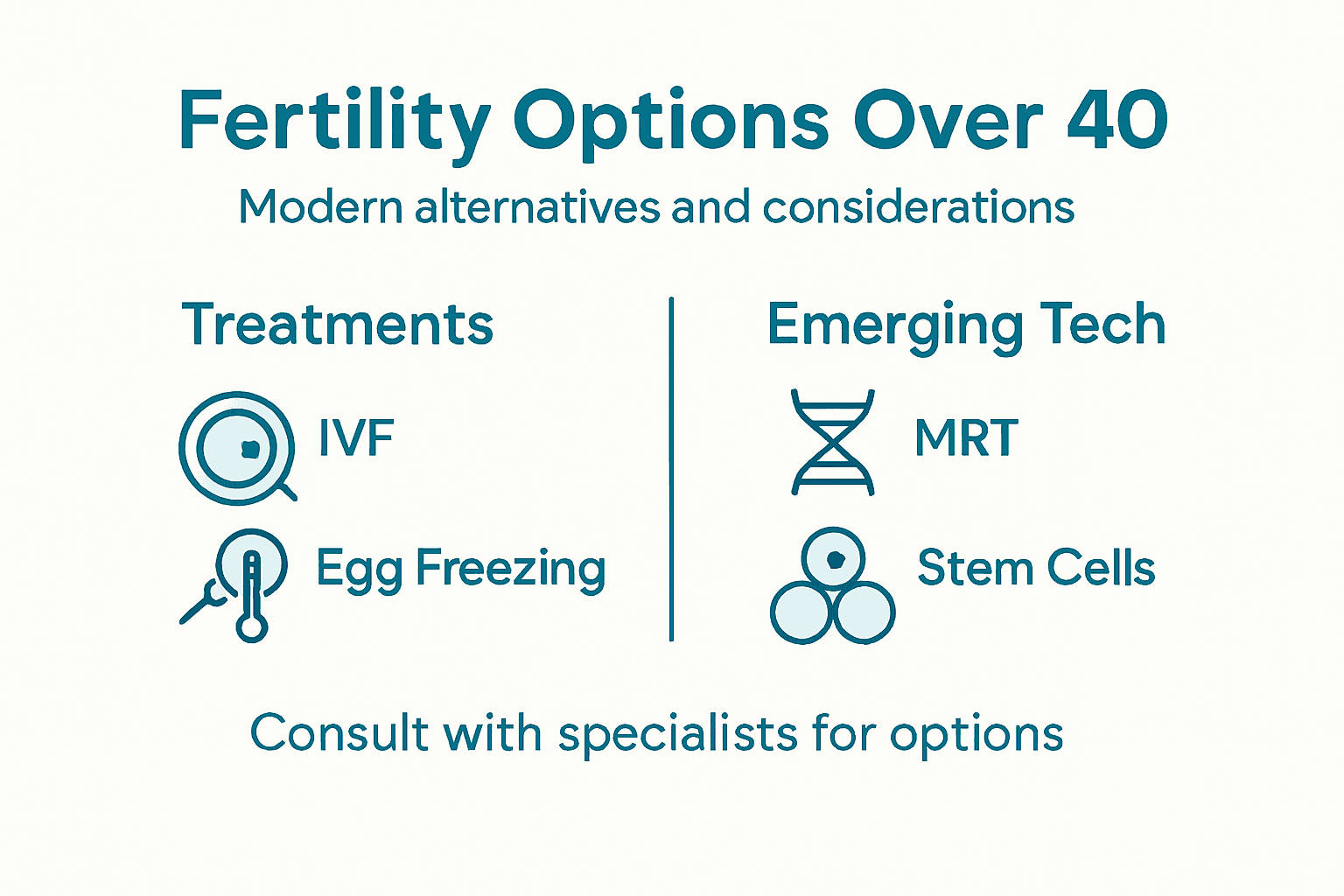
Here’s a side-by-side look at advanced fertility treatment options for women over 40, highlighting unique features and limitations:
Treatment Type | Main Innovation | Ideal Candidate | Notable Limitation |
IVF | Lab-based fertilization | Age-related infertility cases | High financial commitment |
Egg Freezing | Egg preservation for future | Women planning pregnancy later | Lower success at older age |
MRT | Cellular energy optimization | Mitochondrial dysfunction | Regulatory restrictions |
Stem Cell Therapies | Tissue regeneration | Poor egg quality, low ovarian reserve | Not widely available |
Successful fertility interventions require personalized medical strategies tailored to individual physiological characteristics and reproductive objectives.
Pro tip: Consult reproductive specialists who specialize in advanced fertility technologies to develop a comprehensive, personalized treatment approach.
How Advanced Fertility Treatments Work
Advanced fertility treatments represent a sophisticated approach to addressing reproductive challenges for women over 40, combining cutting-edge medical technologies with precise scientific interventions. These treatments go far beyond traditional fertility methods, offering targeted solutions to complex reproductive issues.
The core mechanisms of advanced fertility treatments include:
Ovarian Stimulation: Using hormonal medications to encourage multiple egg production
Genetic Screening: Comprehensive embryo genetic analysis to improve successful pregnancy rates
Precise Egg Retrieval: Minimally invasive procedures to collect high-quality eggs
Advanced Fertilization: Techniques like intracytoplasmic sperm injection (ICSI)
Embryo Transfer: Strategic placement of most viable embryos into the uterus
Mitochondrial Replacement Techniques represent a revolutionary approach in fertility medicine. Advanced genetic intervention methods involve transferring nuclear DNA to optimize cellular energy production and improve fertilization potential.
Each treatment stage requires meticulous medical expertise and individualized planning. Reproductive specialists carefully evaluate genetic factors, hormonal profiles, and specific physiological characteristics to design personalized intervention strategies.
Successful advanced fertility treatments blend sophisticated medical technologies with personalized, patient-centered approaches.
Pro tip: Request comprehensive genetic screening and mitochondrial health assessments during your initial fertility consultation to maximize treatment effectiveness.
Legal and Ethical Framework Worldwide
The global landscape of fertility treatments presents a complex tapestry of legal and ethical considerations that vary dramatically across different national jurisdictions. Women over 40 seeking advanced reproductive technologies must navigate an intricate web of regulations that can significantly impact their fertility options.
Key ethical considerations in international fertility regulations include:
Patient Autonomy: Protecting individual rights to reproductive choices
Genetic Privacy: Ensuring confidentiality of genetic screening results
Treatment Access: Addressing global equity in fertility services
Technological Limitations: Establishing boundaries for emerging reproductive technologies
Informed Consent: Requiring comprehensive patient understanding of procedures
Regulatory Challenges emerge from the rapid advancement of reproductive technologies. Ethical guidelines for emerging fertility treatments must balance innovation with patient protection, addressing complex issues surrounding genetic manipulation, commercialization, and long-term implications of advanced reproductive interventions.
Different countries approach fertility regulations with unique perspectives, creating a patchwork of legal frameworks that can significantly impact treatment accessibility. Some nations embrace cutting-edge technologies, while others impose strict limitations on genetic interventions and reproductive techniques.
International ethical standards must evolve to balance technological innovation with fundamental human rights and patient protection.
Pro tip: Consult legal and medical experts specializing in international reproductive law to fully understand the regulatory landscape of your specific fertility treatment options.
Costs, Safety, and Common Risks Compared
Advanced fertility treatments for women over 40 involve complex financial, medical, and biological considerations that extend far beyond traditional reproductive approaches. Understanding the multifaceted landscape of risks, safety profiles, and potential costs becomes crucial for making informed reproductive decisions.
Key comparative aspects of fertility treatment risks include:
Financial Considerations: Treatments ranging from $10,000 to $50,000 per cycle
Biological Risks: Potential genetic and mitochondrial complications associated with advanced techniques
Success Rate Variability: Pregnancy rates between 20-40% depending on technique
Long-Term Health Impacts: Unknown genetic and developmental consequences
Emotional and Psychological Risks: Potential stress from treatment uncertainty
Treatment Safety Parameters require rigorous scientific evaluation. Comprehensive patient risk assessments must transparently communicate potential medical complications, success probabilities, and emerging technological uncertainties.
Each fertility intervention presents unique risk profiles that vary based on individual medical histories, genetic backgrounds, and specific technological approaches. Reproductive specialists must provide nuanced, personalized risk evaluations that consider both immediate medical outcomes and potential long-term genetic implications.
The table below summarizes key risk and benefit factors to help guide informed choices for advanced fertility treatments:
Aspect | Main Risk | Primary Benefit | Most Impacted Group |
Financial | High upfront costs | Increased pregnancy chances | Older patients |
Genetic | Potential unknown mutations | Lower inherited disorder risk | Families with history |
Emotional | Psychological stress | Emotional fulfillment | All treatment seekers |
Advanced fertility treatments demand a balanced approach, carefully weighing innovative potential against comprehensive medical risks.
Pro tip: Request a detailed, personalized risk assessment document that comprehensively outlines potential medical, genetic, and financial risks specific to your individual case.
Discover Innovative Fertility Solutions Tailored for Women Over 40
Facing fertility challenges over 40 can feel overwhelming when traditional treatments fall short. This article highlights advanced options like Mitochondrial Replacement Therapy and Stem Cell Therapies designed to boost egg quality and ovarian function. If you are seeking personalized, cutting-edge fertility interventions that address age-related decline and genetic concerns, understanding these alternatives is critical for your journey.
At the Rejuvenating Fertility Center in the Bahamas, we specialize in precisely these advanced reproductive technologies. Led by Dr. Zaher Merhi, a pioneer in fertility innovation, our clinic offers tailored treatments including IVF, egg freezing, MRT, and ovarian rejuvenation through stem cell therapy. These scientifically driven solutions are crafted to improve your chances of success even with poor ovarian reserve or genetic complexities.
Take control of your fertility journey today with confidence.
Explore how our state-of-the-art fertility treatments can redefine your options. Visit the Rejuvenating Fertility Center now to schedule your comprehensive consultation and take the first step toward realizing your dream of parenthood with expert care and innovative science.
Frequently Asked Questions
What are the alternative fertility options available for women over 40?
Modern alternative fertility options for women over 40 include Intrauterine Insemination (IUI), In Vitro Maturation (IVM), Low-Cost IVF Systems, Ovarian Rejuvenation therapies, and access to International Fertility Programs.
How does In Vitro Fertilization (IVF) work for women over 40?
IVF involves egg retrieval, fertilization of the egg outside the body, and then transferring the embryo into the uterus. It is a widely used technique to assist women over 40 experiencing infertility issues.
What is Egg Freezing, and how can it benefit women over 40?
Egg Freezing is a process that preserves high-quality eggs at a younger age for future use. This option allows women over 40 to use their younger eggs later when they are ready to conceive, potentially increasing their chances of success.
What are Mitochondrial Replacement Techniques (MRT) and their significance in fertility treatments?
Mitochondrial Replacement Techniques are advanced genetic interventions aimed at addressing mitochondrial dysfunction. MRT can help improve fertilization potential by optimizing cellular energy production, which is especially beneficial for women facing age-related fertility challenges.
Recommended
Comments